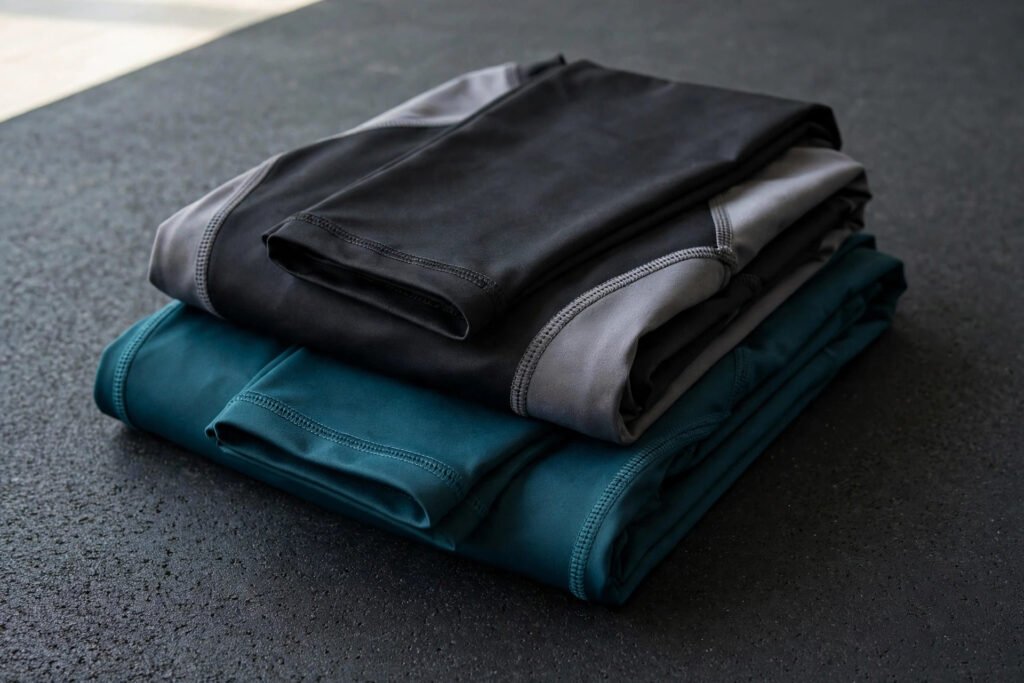
A rash guard looks like a simple fitted top, but in a BJJ or MMA gym it does a lot of work. It protects skin on the mat, carries the gym brand where everyone can see it, and it gets washed more than almost any other piece of training kit. If you run a gym or an academy, ordering custom rash guards is a decision about fabric, fit and printing that will show up in every class. This guide covers what to specify so the tops last, fit right and read clearly as your brand. See our custom rash guards
What Makes Good Custom Rash Guards
A rash guard has to stay close to the body through every position. In BJJ that means guard work, scrambles, takedowns and submissions, and in MMA it means striking, clinching and ground work in the same round. A loose top rides up, bunches under a gi, and gives an opponent something to grab. A fitted top with a longer body stays tucked, protects the skin on the mat, and keeps branding visible instead of hidden under folds. Look for a cut with room across the shoulders and a body long enough to stay in place when a student raises both arms overhead. Flatlock stitching is worth specifying too: it sits smooth against the skin, avoids the chafing standard seams cause during ground work, and holds up better under repeated pulling.
Fabrics That Handle Grappling and Sweat
The fabric is the first decision, and it matters more in a rash guard than in most gym wear. A polyester and spandex blend with four way stretch is the usual choice: it moves with the body, returns to shape after stretching, wicks sweat away from the skin, and dries quickly between rounds. Look for a knit around 180 to 220 GSM, which gives enough weight to resist grabbing without feeling heavy, and a slightly tougher weave for tops worn under a gi every day. Cotton blends feel soft and look good as leisure wear, but they hold moisture and get heavy during hard training, so keep them for hoodies and walkout tees rather than kit that gets worked in every day. Our activewear catalog shows the range of fabrics and fits we can produce for gyms.
Long Sleeve, Short Sleeve and Ranked Designs
Most gyms need more than one style of rash guard, and each one has its own job. Long sleeve tops give the most skin protection on the mat and are the standard choice for BJJ training, especially for beginners and for students who train in a gi. Short sleeve tops feel cooler, dry faster, and suit MMA training and no gi classes where a fighter needs free arms for striking and clinching. Many academies order both in the same colours and branding, so the whole room reads as one team. Ranked designs need extra care. If you use belt colours on the rash guard, keep the rank panel simple and in the same place on every size, so a white belt top and a black belt top are easy to tell apart at a glance, and keep the back print large enough to read from across the mat.
Printing and Branding That Survive the Mat
Rash guards get washed far more often than most teamwear, and they get pulled and rubbed on the mat, so the decoration method matters. Sublimation printing dyes the design into polyester fibres, which means it cannot crack or peel and adds no weight to the fabric. It is the best choice for bright, all over colour and for large back prints. You can read more about how it works in our guide to sublimation printing on jerseys. Keep small crests and sponsor marks embroidered, small, and away from high stretch zones so they do not pucker or rub skin on the mat. Avoid heavy vinyl prints on the chest or back: they trap heat and stiffen the fabric where a student needs it to breathe. Wash a sample several times and train in it before approving the bulk run.
Sizing, Quantities and Ordering for a Gym
Gyms order differently from clubs, because one order has to cover students, coaches, juniors and supporters. Collect sizes before you place the order rather than guessing, and build the size curve around your real membership, with extra stock in the middle sizes. Rash guards are fitted, so a size chart alone is not enough: ask members for a chest measurement as well as a top size, and have a real student train in a sample in the most common size for a full week before you approve the bulk run. Fabricory’s minimum order is 50 pieces, which can be split across long sleeve and short sleeve styles and across sizes, so a gym can order a full range in one run. If you are thinking about selling gym wear under your own brand, our guide to starting a private label gym wear brand explains the practical steps. Allow time for sampling and approval before the bulk run, and agree the delivery window with your supplier in writing.
Ready to kit out your gym? Send us your brief and we will help you choose fabrics, styles and sizes for your custom rash guards. Request a quote today
Ready to start? Request a quote.