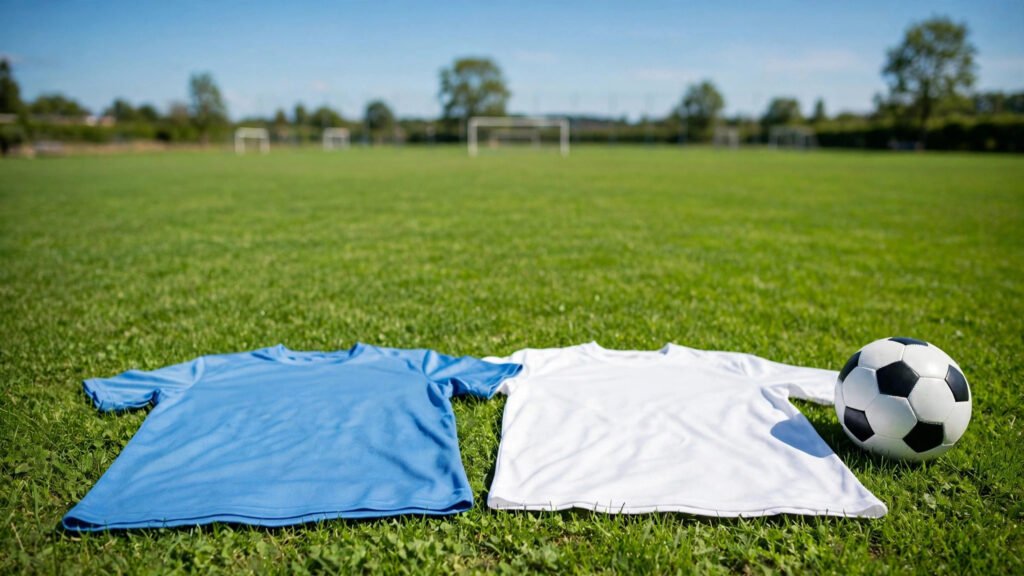
Same game, different words
“Soccer” is the word used in the United States, Canada, Australia, and a few other countries. “Football” is used almost everywhere else. When you order custom soccer jerseys from an American supplier, or football kits from a British or Pakistani one, you are describing the same thing: a short-sleeved athletic shirt made for the game played with a round ball.
Short answer: a jersey is just the top. A kit is the complete uniform — jersey, shorts and socks that match. In the UK ‘kit’ is the everyday word; in the US, ‘jersey’ usually means the shirt, and the full set is a uniform.
When you compare soccer jerseys with football kits, check whether the price covers shirts only or the full matched set.
This matters most when you compare quotes. If you ask three factories for prices and call it “soccer jerseys” in one email and “football kits” in another, you may confuse your own records. Pick one term for your project and use it consistently in every quote request, tech pack, and email thread.
Jersey vs kit: the packaging difference
Here is the one genuine distinction. A “jersey” is the shirt alone. A “kit” is the full set: the shirt plus shorts, and often socks to match. In the UK, when a club orders football kits, it usually means the whole outfit. In the US, when a coach orders custom soccer jerseys, it usually means shirts only, with shorts ordered separately.
That difference shows up in pricing. A quote for “50 kits” includes shorts. A quote for “50 jerseys” may not. Before you sign anything, confirm in writing whether the price covers shirts only or the full kit. This is the single most common source of budget surprises in teamwear orders, and it has nothing to do with quality or country of manufacture.
The garment itself is identical
Whatever you call it, the product follows the same pattern. A modern soccer jersey or football kit shirt is made from lightweight polyester, usually between 150 and 180 GSM, with moisture-wicking properties and a sublimated design. Sublimation printing, where the design is dyed into the fabric rather than printed on top, is the standard for team uniforms because it never cracks or peels. You can read how it works in plain terms in our guide to what sublimation printing is.
Fabric choice follows the climate, not the vocabulary. A club in Texas and a club in Manchester order the same polyester interlock or mesh; the Texan team just picks lighter mesh panels under the arms. Fit is the same too: athletic cut, true to size, with youth and adult patterns available. If you are new to ordering, our buyer’s guide to custom football kits walks through the full process step by step.
Where the words can cost you money
Three places where mixing up the terms gets expensive:
First, minimum order quantities. A supplier quoting an MOQ of 50 may mean 50 shirts or 50 full kits. Ask directly. Fabricory’s MOQ is 50 pieces, and a “piece” is a single garment, so 25 shirts plus 25 shorts is 50 pieces. Other manufacturers count differently, so confirm.
Second, numbering and personalization. American youth leagues usually put numbers on the back. British Sunday league sides often add player names too. The decoration method, sublimation for all-over designs or heat transfer for names and numbers, costs the same either way, but you must state what you want before the quote is final.
Third, delivery timing. The phrase “in time for the season” means August in England and March in parts of the US. Put a hard date in your purchase order, not a season name, and confirm it in writing.
What to specify when you order
Whether you say soccer jerseys or football kits, your order needs the same details:
- Garments included: shirts only, or shirts, shorts, and socks
- Quantity of each item and the size breakdown
- Fabric weight and mesh panel placement
- Full sublimation design artwork, front and back
- Numbers, names, and sponsor logos with placement
- Delivery date, agreed in writing
A manufacturer that cannot answer plain questions about any of these, in whichever words you use, is not the right manufacturer. See our sportswear catalog for the range of garments you can build into a kit, from match shirts to training wear.
The bottom line
Custom soccer jerseys and football kits are the same garment with different names, and the only real distinction is whether “kit” means the full set of shirt, shorts, and socks. What matters is not the word you use but the detail you specify: pieces, sizes, fabric, artwork, and delivery date, all confirmed in writing. Get those right and the terminology takes care of itself.
Ready to order? Tell us whether you need shirts only or full kits, and we will quote accordingly. Get a custom quote.
Ready to request a quote for your team?